
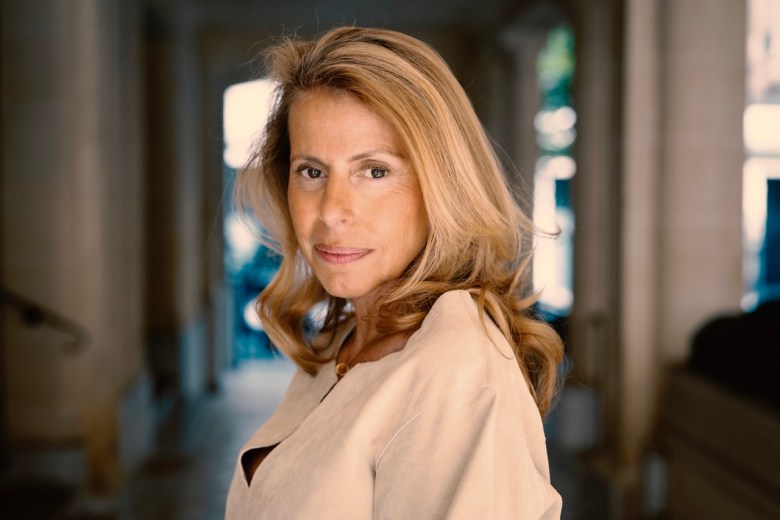
February 2025: Cécile Rap-Veber, CEO of SACEM.
Journey to the centric of the worth: artist-centric licensing debates have tended to be about their impact on recording artists, but there is a push to make this equally a songwriter-centric debate.
A long time in the making, Deezer has now signed a deal with Sacem to pay out streaming mechanicals on a songwriter-centric basis in France, with the hope that other DSPs will fall in line – and that other markets will follow France’s lead here. This, however, is only one way to make things more egalitarian for songwriters. Sacem has ideas for how they can better share in the streaming pot – albeit in a way that DSPs might not be ecstatic about.
Rap-Veber talks about the need for Sacem to run its own data analysis before committing to a new payment model with Deezer, why songwriters are too often overlooked in new royalty payment model debates, where the profligacy of streaming services needs to be reined in, and why DSPs taking a 30% cut need to rethink this in terms of how they pay songwriters better.
Tremendous amounts of lip service has been paid by the music industry to the recording artist and the songwriter – that they are the very centre of the music business and without whom there would be no business. Except in streaming, they have not been (across the board) the centre of royalty payments.
Both Deezer and SoundCloud have been pushing for a shift away from pro rata payments and towards a user-centric or artist-centric model (there is some semantic tussling over how it is referred to). This is trumpeted as being much more egalitarian – but not completely egalitarian, as we will get to.
Deezer and SoundCloud appeared to be howling into a void for years, but now Universal Music Group is loudly talking about its “commitment to artist-centric principles”, notably in its recently renewed deal with Spotify. UMG was not an early flag-waver for the model, but now it is, which all adds greater heft to the movement.
A long time coming
A lot of the focus has been on the recorded side of the royalties pool, but Sacem in France recently swung that focus towards songwriters and publishers via its deal with Deezer – the two companies terming it “the world’s first update to the remuneration model for publishing in the streaming era”. Currently only applicable in France, it is seen by Sacem as just the first step: more DSPs and more markets should fall in line, it believes.
It has been a long time coming, as the two companies announced in late 2023 that they were going to investigate the viability of the new payment system.
“[Deezer] came to us maybe five years ago and they really pushed hard to convince us that the user-centric model, as it was called at that time, was really the best [way] to rebalance, a bit, the distribution [of revenues],” says Cécile Rap-Veber, CEO of Sacem.
The CMO discussed it with its members – who were “absolutely not unanimous” – and it became a highly emotive issue. Sacem felt that previous studies into the pros and cons of this model had left out songwriters in their tabulations and this needed to be addressed to give its members the necessary hard facts to base their decisions on.
“I’m not talking about 10% or 20% of growth, but it’s significant enough to adopt the system”
“I love my partners, but I prefer to trust real data,” says Rap-Veber. “We’ve been really transforming our society in data [terms]. I told [Deezer], ‘You’re going to send me the files and I will do my own analysis.’ [Previously], all the analysis of Deezer was based on labels and performance revenue. There was nothing about publishing and songwriters.”
The findings were that some genres might experience a slight dip following a switch in the payment system, but that, in aggregate, most songwriters would benefit.
“We ran the analysis and we came to the conclusion that it’s true that some repertoire is penalised, but it’s really niche – what we can call a kind of hardcore rap where you have very small numbers of fans, but they spend thousands of hours, apparently, streaming – and the rest is not so penalised,” she says.
Sacem has not issued precise numbers on the types of increases writers can expect. “I’m not talking about 10% or 20% of growth,” says Rap-Veber, “but it’s significant enough, I think, to adopt the system.”
A shift in emphasis to songwriters
What the Deezer deal will achieve, she believes, is delivering empirical data to put in front of other DSPs in order to push for them to take a songwriter-centric approach to distributing publishing royalties.
“My idea is to now reach out to Spotify and to make analysis on their own artist-centric model, because it’s not exactly the same,” reveals Rap-Veber. “Once we have implemented the Deezer solution, and there will be concrete results on the distribution files for our members, our partners and our publishers, they should push hard with us. That won’t only be Sacem.”
Having watertight numbers around songwriter royalties is critical here to move away from the emphasis on recording artists. “I don’t want to rely only on the master, producer and performer side,” she says of Sacem’s own data analysis. “I need to have concrete data on our publishing and creator side.”
This update to payments will have material benefits for many songwriters, Sacem asserts, but this is all very far from a panacea. Writers, Rap-Veber believes, need a bigger share of overall streaming income.
“Of course, they can say that 30% margin is not enough. But when I see the valuation of the company [Spotify]… don’t make me laugh. Honestly, they have money.”
We talk about where any increase in mechanicals would come from. I say that labels are unlikely to willingly reduce their share and recording artists already feel shortchanged enough here that it would land extremely badly for them to be asked to reduce their share. That leaves the other part of the ecosystem – the DSPs, who take on average 30% of total income generated here.
“For me, the 30% margin should be taken and should serve the interests of the songwriters and the producers,” says Rap-Veber, bluntly. “Of course, they can say that 30% margin is not enough. But when I see the valuation of the company [Spotify]… don’t make me laugh. Honestly, they have money.”
The philosophy of profit
She feels the freewheeling profligacy of DSPs in certain areas needs to be cut back on and that money instead gets filtered through to songwriters.
In the wake of the LA fires, Spotify announced it was cancelling its Grammy Week events and “redirecting funds to support efforts to reach local fans and charitable organizations”. That involved donating to MusiCares and FireAid as well as “dedicating on-platform promotion and offering pro bono ad inventory to drive awareness of causes supporting the relief and artist and creator support via studio time at our LA office in the Arts District”. In total, Spotify says it will donate $5 million.
All very noble. Rap-Veber, however, feels heavy spending on parties and certain major promotions could be money that is better used elsewhere.
“I don’t understand why Spotify, Deezer or Apple should have better value from streaming than the creators themselves.”
“I see the amount sometimes invested in a soccer team or something like that,” she says, referring to Spotify’s four-year sponsorship of Barcelona. “You’re ready to give €400 million [actually reported to be €280 million] to promote your brand on a T-shirt, but not to pay the songwriters properly? We’re talking about humans, and, especially in a time where AI is coming and there is more and more competition, we should preserve [this].”
She feels the long-running issue of “unprofitability” has been politically exploited by DSPs to justify the size of their cut of the revenues brought in, but this argument is something she believes is increasingly difficult to stand up.
“Now we see the valuation of Spotify and the millions that Daniel Ek has every year, especially when he sells all his shares,” she says. “Plus the fact that Deezer has declared that it should be profitable this year. It’s totally unfair to see that the margin of the DSP is 30% but then the ones who have created the content, who created the value in the song before anything else, get under 20%. I will keep fighting to get better value for my members because I don’t understand why Spotify, Deezer or Apple should have better value from streaming than the creators themselves.”
In a fully French flourish to end, she threads existential notions through economic realties. “It is a philosophical question,” she says of the need to better reward songwriters. “We’re talking about the future of humanity. Maybe [the DSPs] don’t care, but they should care. Honestly.”