
We’ve seen a growing slate of deals between major labels and AI-music companies that include the former’s publishing arms.
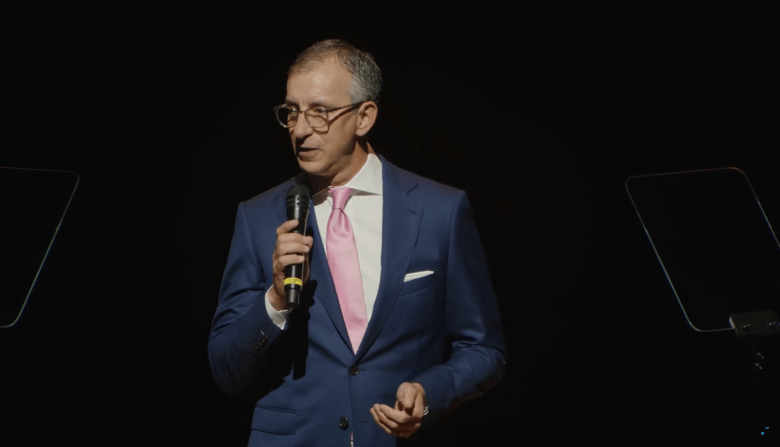
Now US music-publishers body the NMPA has announced two of its own agreements: with Udio and Klay. The deals were revealed by CEO David Israelite at the NMPA’s annual meeting yesterday (10 June) – and the Udio deal has one notable term.
“This deal delivers something that we have always demanded. Songs are just as important, if not more, than sound recordings when it comes to AI training,” said Israelite. “I am thrilled to report that in this first-of-its-kind, industry-wide deal, the training will value songs and sound recordings equally.”
It’s not the first deal with this structure: that honour goes to Kobalt’s agreement with ElevenLabs. But as Israelite pointed out, the principle has now been extended to a deal open to all of the NMPA’s members, who will be reviewing the terms and deciding whether to opt in over the coming weeks.
“There has not been any deal offered across the entire market, until today,” he said. The NMPA’s deal with Klay is an agreement in principle at this point, and will launch later this summer for review by members.
“As court cases play out, and as policymakers grapple with legislation, we are laser-focused on also paving the path forward through licensing,” said Israelite during his presentation. “Litigating against bad AI actors, and licensing good AI partners is not in conflict. NMPA will do both.”
He later returned to the first part of that equation. “Both of these agreements represent real progress toward AI and creators working together and benefitting both sides,” said Israelite. “And for companies that don’t take this approach, you know what’s coming!”
The NMPA event also saw COO and CLO Danielle Aguirre deliver some new numbers for the US publishing sector, revealing revenues of $7.29bn in 2025, noting the long-term growth since 2014, when those revenues were $2.17bn.
Aguirre also called attention to publishing revenues growing faster than recorded music for the fourth consecutive year “despite some significant challenges to the value of songs”.
One in particular: the impact of audiobooks-and-music ‘bundles’ launched by Spotify and Amazon Music, which under the terms of the US licensing regime pay a reduced rate compared to standalone music-streaming services.
“As an industry, we felt the very real effects of Spotify’s bundling scheme, followed by Amazon’s bundling, which reduced those companies’ royalty streams and payments by approximately 30%,” said Aguirre.
“By Spotify’s own estimates, those so-called bundles have cost songwriters and publishers almost $480m in royalty payments since they were implemented in 2024.”
As ever, these are stats sourced from Spotify itself. Its latest quarterly-financials filing updated the figure for how much it would have to pay if the US Mechanical Licensing Collective prevails in its lawsuit over its bundling: approximately €410m, which is $473m at current exchange rates.
This is the extra money that Spotify would have paid publishers since 2024 if it hadn’t switched to the bundle rates. This is a long-running point of tension between the NMPA and Spotify, and judging by yesterday’s event, it has some more running yet to do.