


Eamonn Forde Meets… – each month, the veteran music business journalist speaks to a senior industry figure about the topics that really matter – and gets the opinions of the people who make the decisions that count.
September 2024: Lee Anderson, President of Wasserman’s music division. Festival-ley of darkness: the death spiral of the music festival is simultaneously over- and under-exaggerated. The biggest keep getting bigger, but those in the squeezed middle gasp for breath while new entrants face seemingly impossible survival odds. The need for a clear identity and a clearer purpose has never been greater.
Anderson argues that good festivals are far from facing extinction but that bolder and braver booking policies can change things for those at risk; notes headliners are increasingly having to look at festivals to make statements rather than make fortunes; reveals how lookalike festivals are damaging the market; but insists the talent pipeline is there, not necessarily just from the markets the festival business has been so lazily reliant on for too long.
The British music festival is doomed? Maybe. The roadkill tally of cancelled or postponed British music festivals is rising to terrifying levels? Unquestionably.
Economist Will Page recently noted how 52 festivals in the UK were being buried or put on hiatus this year. That becomes a highly symbolic number, equal to a festival for each week of the year. That’s how oversubscribed the festival sector is. Too many festivals. Not enough customers. And even fewer weeks in the year to go round.

The Association of Independent Festivals is also warning that, without intervention, up to 100 UK festivals could disappear this year.
For Lee Anderson, president of heavyweight bookings agency Wasserman Music (a role he formally took up in June this year), it is all worthy of a retooling of the great line from Mark Twain in 1897 (which was revived, somewhat ironically, by Paul McCartney in 1969): reports of the festival’s death are greatly exaggerated.
It is, as with all things in the music business, a matter of perspective.
“You do hear chatter about it,” says Anderson. “Everyone’s always looking for a hit piece on Coachella here or clickbait there.”
He points to a boom in boutique festivals in the US with sub-50,000 capacity like Portola in San Francisco, Under The Big Sky in Montana or Two Step Inn in Texas. He also points to Latin America where similar trends are clear. “That’s where you’re dealing with a number of nations that have got some real economic crises but they are still doing over 100,000 tickets in some of these markets.”
The problem may really lie in two overlapping dynamics: there are too many lookalike festivals competing for the same acts; and the heavyweight headliners are now able to make more money from their own shows than they do from festivals.
Anderson dates the former issue to the late 2000s and early 2010s when “you’d see a lot of things that were replicating a Lollapalooza-type event”, effectively all competing for the same acts and the same audiences.
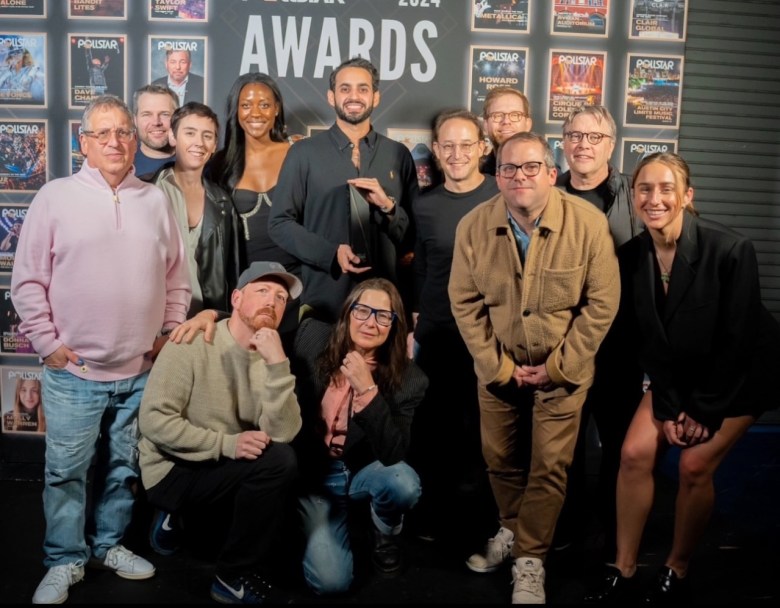
Anderson with other members of Wasserman Music’s leadership at the 2024 Pollstar Awards Credit: Courtesy of Pollstar
For the latter issue, he says we need to look at the changing economics of live and the maturation of the touring business. In the 2010s, a huge act could gross anywhere between $1 million and $2 million to headline a festival, but might only walk away with $500-600,000 for a couple of nights at an arena.
Today, he says, a superstar like Drake could gross $5 million at an arena show and other big acts could gross up to $2.5 million.
“That’s because the industry has figured out how to actually capture that revenue before it hits the secondary market,” he says. “That economy existed, but the ticketing industry, the agencies and the artists just weren’t figuring out how you kept the pot for the talent or the promoters that share in the money.”
Plus arenas are now just staging posts on the way to stadiums, previously the preserve of a few mega-acts like The Rolling Stones.
There are too many lookalike festivals competing for the same acts; and heavyweight headliners make more money from their own shows
“Look at the number of artists that are knocking out stadiums now,” he says. “Whether it’s packages of Green Day with a couple of rock bands going in or The Weeknd getting there. That is attainable. And the touring industry has become so sophisticated and so smart […] To go out and actually play when you’re thinking about your business and what you can earn on your own or sell merch to your own fans, that has shifted away from the festival.”
There is also the desire for acts to play to their own fans rather than face a festival audience who might be largely indifferent to their work beyond the hits.
The chokepoint in the festival business is down to too many people seeing it as a gold rush and an easy way to make money, but who have not really thought through what they are doing that is different or desired.
“You started to get all these circuits where they all look exactly the same,” argues Anderson. But there is a backlash brewing against this, he feels. “What you’re beginning to see, particularly with these boutique festivals that come up in certain cultural ecosystems, is that they’re highly curated again.”
“When you create those [transcendent] moments for your artist, that’s what builds the legend of that talent”
Lee Anderson
While huge acts can make more money from tickets at their own headline shows, plus sell more merchandise and have greater control over the event, that does not preclude them from considering festivals, especially if they can symbolise something far beyond the show itself.
“When I think about what’s going on with my clients, the conversations I have [with festivals] are, ‘What’s the moment? How are we creating the moment? What’s the time slot? How do you envision the flow of it? What’s it up against? What’s this moment going to look like for my artist?’”
The goal is to have a show that transcends the festival. “When you create those moments for your artist, that’s what builds the legend of that talent,” he argues. “That’s what makes people remember them forever and always want to go back.”
Creating the moment should, in these instances, outweigh just grabbing the fee.
“Honestly, if you’re just thinking about it from the business standpoint, or the economics, or how you can run the margins the best way and get to all these places where you have fans, you can do that all day on touring and just headline it yourself,” says Anderson. “If you’re going to go out and do these kinds of things, I think you should do them because you’re creating lasting moments that people remember for decades.”

There has been a lot of discussion about competition for headliners and the “pipeline” not being sufficient to develop the headliners of tomorrow (especially more diverse headliners). Anderson suggests the live business needs to look a lot closer to home to fix this.
“If the talent buyer is having a hard time getting talent to play, or maybe headline their events, I would ask them to maybe look in the mirror and say, ‘What can we do to make this more appealing to people? Why don’t people want to play here?’” he proposes. “Not everyone who buys talent is great at it or a visionary.”
Braver talent buyers and bookers are the only way out, he feels.
“Do people need to take more of a risk?” he asks. “Of course they do. They need to be intelligent and buy in at the right time, to get in early and get it so that it aligns with that moment and that peak heat source and momentum when the day comes of the actual event. You see loads of headliners coming through all the time. You just need to pay attention to that. Billie Eilish came out of nowhere and everybody wanted her to headline and she could carry it.”
Reimagining music festivals beyond the UK/US talent axis will also be critical to their future. Anderson points to the increasingly and truly international lineup at Coachella which understands there are huge Korean, Japanese and Latino populations within the catchment area of the festival site so the lineup needs to reflect that. He also points to the rise of Afrobeats as somewhere the next wave of festival headliners will come from.
Because of streaming, consumers are now much more eclectically international in their listening, so festivals should also reflect (and thereby accelerate) these changes.
“You’ll see a different audience go and attend those concerts,” he says. “And you’ll see these acts really become in-demand in terms of the festivals.”
There will always be too many festivals because they are a tantalising economic opportunity that too many organisers are prepared to bet on, even if they have not properly mitigated against the many inherent risks. As long as freewheeling festival capitalism exists, supply will always outstrip demand. Festivals themselves will not die. But old-style festivals, in terms of lineups and economic philosophies, will increasingly perish. Only re-imagination can lead to regeneration.

